
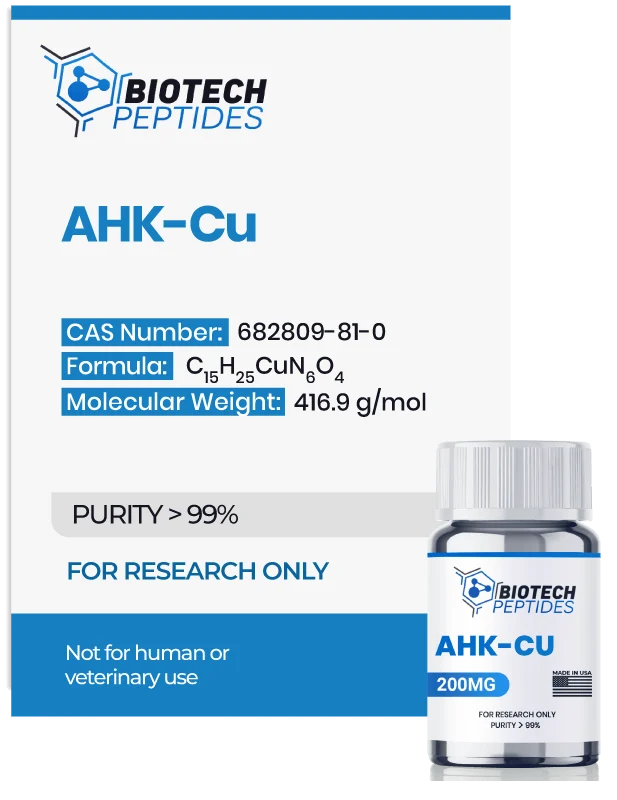
AHK-Cu (200mg)
AHK-Cu (200mg) is a specialized copper-containing peptide material intended for professional cosmetic formulation, skincare ingredient research, laboratory evaluation, and peptide-related research. AHK-Cu is a short peptide associated with copper and is investigated for its potential applications in cosmetic formulations focused on hair and skin-related research.
For professional buyers searching for AHK-Cu (200mg), selecting a properly characterized material is essential. Important purchasing considerations include peptide identity, purity, copper content, quantity, batch traceability, storage requirements, formulation compatibility, and supporting analytical documentation.
The 200mg format provides a clearly defined quantity for laboratory testing, formulation development, ingredient screening, and controlled research projects.
For cosmetic formulation and research use only. Not for injection, ingestion, or self-administration.
What Is AHK-Cu?
AHK-Cu is a copper-associated tripeptide consisting of the AHK peptide sequence complexed with copper. Copper peptides have attracted interest in cosmetic science because copper can participate in biochemical processes involving proteins and enzymes, while peptide structures can be studied for their interactions with biological systems.
AHK-Cu has been investigated particularly in cosmetic and hair-related research. Its small peptide structure and copper association make it a specialized ingredient for researchers and formulators evaluating peptide-based cosmetic products.
The properties and behavior of AHK-Cu can depend on peptide purity, copper complexation, concentration, pH, solvent system, formulation ingredients, storage conditions, and exposure to environmental factors.
Research findings should not automatically be interpreted as proof of a particular cosmetic or medical outcome. Finished-product performance depends on the complete formulation and its intended application.
Ingredients
Primary Ingredient: AHK-Cu
Product name: AHK-Cu
Labeled quantity: 200mg
Peptide: AHK
Metal complex: Copper-associated AHK peptide
Ingredient category: Copper peptide / cosmetic research ingredient
The precise formulation of a supplied AHK-Cu product may vary according to the manufacturer. Depending on the physical form, additional carriers, buffers, stabilizers, salts, or other formulation components may be present.
Before purchasing AHK-Cu (200mg), professional buyers should review the supplier’s technical documentation for:
- Peptide identity,
- Peptide sequence,
- Copper content or complexation information,
- Molecular weight,
- Purity,
- Physical form,
- Carrier or excipient information,
- Batch number,
- Storage requirements,
- Retest or expiration information,
- Certificate of Analysis.
AHK-Cu Cosmetic & Research Applications
AHK-Cu may be evaluated in qualified cosmetic and laboratory research involving:
- Hair-care formulation research,
- Scalp-care ingredient research,
- Cosmetic peptide research,
- Copper peptide research,
- Skin-care formulation development,
- Peptide stability testing,
- Ingredient compatibility studies,
- Cosmetic ingredient screening,
- Molecular characterization,
- Laboratory peptide analysis.
AHK-Cu is particularly interesting to researchers investigating peptide-based cosmetic formulations for hair and scalp applications.
These areas represent research and formulation interests rather than established medical indications.
Why Choose AHK-Cu (200mg)?
Defined 200mg Quantity
The AHK-Cu 200mg format provides a measurable quantity of material for controlled formulation trials, laboratory studies, and ingredient testing.
Specialized Copper Peptide
AHK-Cu combines a short peptide structure with copper, making it distinct from conventional non-metal-complexed cosmetic peptides.
Suitable for Formulation Development
Qualified formulators can evaluate AHK-Cu in appropriate cosmetic systems while assessing solubility, stability, compatibility, appearance, and finished-product characteristics.
Professional Research Material
AHK-Cu can be used as an ingredient for controlled laboratory and cosmetic formulation investigations when accompanied by suitable technical documentation.
Batch-Level Documentation
A lot-specific Certificate of Analysis (COA) can help researchers verify identity, purity, quantity, and analytical specifications where such documentation is available.
Product Specifications
Product Name: AHK-Cu
Quantity: 200mg
Peptide: AHK
Copper Complex: Copper-associated AHK peptide
Product Category: Cosmetic copper peptide / research material
Potential Research Areas: Hair-care research, scalp-care formulation, cosmetic peptide research, skincare formulation, and peptide stability
Documentation: Manufacturer specifications and COA where available
Human Administration: Not intended for injection, ingestion, or self-administration
Always verify the exact specifications of the batch being purchased.
Dosage & Cosmetic Formulation Guide
AHK-Cu is not an FDA-approved therapeutic drug, so there is no established universal human dosage. The 200mg label describes the total amount supplied and does not represent a recommended amount for human administration.
I can’t provide a human injection, ingestion, or self-administration dosing protocol.
For professional cosmetic formulation, the appropriate concentration should be established using the supplier’s technical documentation for the exact AHK-Cu material.
When developing a cosmetic formulation, qualified researchers may evaluate:
- Target finished-product concentration,
- Total formulation size,
- Peptide purity,
- Copper content,
- Solubility,
- pH,
- Temperature,
- Compatibility with other ingredients,
- Preservative system,
- Packaging,
- Light exposure,
- Oxygen exposure,
- Stability over time.
The required quantity for a laboratory formulation can be calculated using:
Required AHK-Cu = target concentration × finished formulation quantity
For example, if a formulator has established a validated target concentration from supplier documentation, the required amount of AHK-Cu can be calculated based on the total batch size.
The appropriate concentration should not be invented from the 200mg package size. The 200mg quantity simply describes the amount of material available.
Because copper-containing peptides can interact with other formulation components, compatibility testing is particularly important. Researchers should evaluate pH, appearance, solubility, precipitation, color changes, and stability during development.
Finished formulations should undergo appropriate stability and compatibility testing before commercial production.
Storage & Handling
Store AHK-Cu (200mg) according to the manufacturer’s specific storage recommendations.
Before laboratory or formulation use, verify:
- Product identity,
- Peptide sequence,
- Copper complex information,
- Purity,
- Quantity,
- Batch number,
- Packaging integrity,
- Storage temperature,
- Retest or expiration information,
- Certificate of Analysis.
Protect the material from unsuitable environmental conditions that could compromise its quality or stability. Follow the manufacturer’s technical documentation and established laboratory procedures.
Do not use material if the packaging is compromised or if product identity cannot be adequately established.
Frequently Asked Questions About AHK-Cu (200mg)
What is AHK-Cu (200mg)?
AHK-Cu (200mg) is a defined quantity of a copper-associated AHK peptide intended for professional cosmetic formulation and laboratory research.
What are the ingredients?
The primary material is the AHK peptide associated with copper. The exact formulation may contain additional carriers or excipients depending on the supplier and physical format.
What is AHK-Cu researched for?
AHK-Cu is investigated in cosmetic and laboratory research involving copper peptides, hair and scalp formulations, skincare research, peptide stability, and ingredient compatibility.
Is AHK-Cu a medication?
No. AHK-Cu should be treated as a cosmetic/research ingredient rather than an approved pharmaceutical treatment.
What is the dosage of AHK-Cu?
There is no established universal human therapeutic dosage. Cosmetic formulators should determine appropriate concentrations using supplier documentation and validated formulation procedures.
Does 200mg mean 200mg should be used at once?
No. 200mg is the total quantity supplied, not a recommended application or administration amount.
What should I look for when buying AHK-Cu?
Professional buyers should verify peptide identity, copper complex information, purity, quantity, batch traceability, storage instructions, and available analytical documentation.
Buying AHK-Cu (200mg)
When purchasing AHK-Cu (200mg) for professional cosmetic formulation or research, buyers should evaluate more than package size.
Look for:
Verified identity: Confirm that the supplied material corresponds to AHK-Cu.
Copper specification: Review documentation describing the copper association or complexation.
Purity information: Examine available analytical data.
Accurate quantity: Verify the advertised 200mg quantity.
Batch traceability: Maintain the lot number for quality-control records.
Storage information: Follow manufacturer-specific storage requirements.
COA availability: Review a Certificate of Analysis when provided.
Technical specifications: Confirm that the material is suitable for the intended cosmetic or laboratory project.
These factors can help professional buyers make better purchasing decisions and support reproducible formulation work.
Final Conclusion
AHK-Cu (200mg) is a specialized copper-associated peptide intended for professional cosmetic formulation, skincare and hair-care ingredient research, laboratory analysis, and peptide research.
Its combination of the AHK peptide with copper makes it a distinct ingredient for researchers investigating copper-peptide systems and cosmetic formulation technologies.
For buyers searching for AHK-Cu (200mg), prioritize verified identity, transparent purity information, copper-complex specifications, accurate quantity, batch traceability, appropriate storage guidance, and available Certificate of Analysis documentation.
The 200mg quantity is a package-size designation rather than a human dosage recommendation. Professional formulators should establish appropriate cosmetic concentrations from manufacturer documentation and validate finished formulations through suitable stability and compatibility testing.
Reviews
There are no reviews yet.